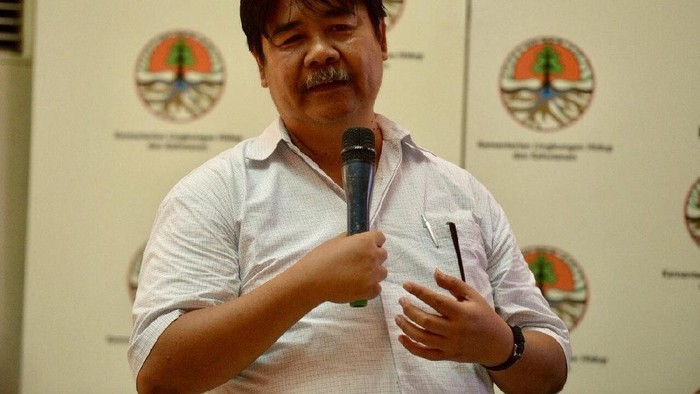
One afternoon, a message came into Bambang Hero Saharjo's WhatsApp from his daughter.
"What's this now?" she asked, referring to a screenshot of a news headline from Kumparan she had sent along with the message. The headline read, "IPB Professor Who Calculated the Country's Losses in the Corruption of Tin Worth 271 Trillion, Reported to the Police by Residents of Babel."
Bambang didn’t respond immediately. He only replied an hour later, after his daughter had called for the third time. However, rather than directly answering her question, he sent her a screenshot of the article.
"That's the Attorney General's response. Okay?"
"Is it alright? The buzzers are going crazy," his daughter asked.
"Yeah, it's fine. It should be the judge who gets criticized," he replied.
"Why the judge?"
"Because the judge is the one who accepted your father's findings."
"I don't get it," his daughter said.
Bambang sighed. He knew his daughter was worried, thinking that being reported to the police could lead to imprisonment. "The media language is intense: 'I’ve been reported to the police.' The headline sounds scary," he said on Wednesday, February 19, 2025, at the IPB Baranang Siang campus in Bogor.
An analysis conducted for the "Environmental Defenders' Status in Indonesia 2014-2024" research found that several media outlets, including mainstream ones, all used the keyword “reported to the police” in articles about Bambang Hero, who had been reported by the Bangka Belitung-based organization Perpat to the Bangka Belitung Police on January 8. For instance, Kompas titled their article “Profile of Bambang Hero Saharjo, the IPB Professor Reported to the Police in the Harvey Moeis Case.” Similar headlines appeared in Detik, Media Indonesia, and Suara.
The use of the phrase “reported to the police,” Bambang explained, carries the connotation that he has been detained by the police, akin to words like "dismissed" (sent home) or "imprisoned" (sent to jail). "In fact, I've just been reported to the police," he said.
As Bambang recalls, only a few media outlets avoided using the phrase “reported to the police” at that time, including Tempo and Betahita. Tempo's headline was "Bangka Belitung Ormas Reports Bambang Hero...". "I guess the media used that phrase to get people to click on the article," he speculated.
The Counterattack of the Corrupt
Bambang was reported to the police by Perpat for calculating the environmental damages in the case of corruption in the illegal tin trade in Bangka Belitung for the Financial and Development Supervisory Agency (BPKP), in addition to being an expert witness for the Attorney General’s Office in the case in court. According to Bambang and his colleagues’ calculations, the environmental damage from the corruption case amounted to IDR 271 trillion, including environmental losses of IDR 183.703 trillion, economic losses of IDR 74.493 trillion, and environmental recovery costs of IDR 12.157 trillion.
This became the largest environmental loss case in Indonesia's history. On December 23, 2024, the judge sentenced six out of 22 defendants in the case to prison terms of 4 to 8 years and fines ranging from IDR 750 billion to IDR 210 billion. The sentenced individuals included Harvey Moeis (CEO of PT Refined Bangka Tin/RBT), Suparta (Director of Business Development at RBT), Reza Andriyansyah (beneficiary of PT Stanindo Inti Perkasa), Suwito Gunawan (Director of PT Sariwiguna Binasentosa), and Robert Indarto and Rosalina (General Managers of PT Tinindo Internusa 2017-2020).
Various parties felt that the sentences were disproportionate to the scale of the environmental damage. Bambang shared this sentiment. “I was sad. At that time, I thought, why is it like this? We worked so hard. Uncovering this wasn’t easy,” he said.
What Bambang didn’t foresee was that the lenient sentences would trigger a chain reaction. It seems that this verdict became a moment for a counterattack against him, which peaked between January 8-11, 2025.
The backlash against him was carried out through the media. On January 5, at 8:30 PM, for example, JPNN.com published a news article titled "Kejagung Needs to Be Transparent in the Rp 300 Trillion Corruption Case." The article quoted Perwira Siregar, Secretary-General of the Central Leadership Council of Cendekia Muda Muslim Indonesia (DPP CMMI), questioning Bambang’s calculations. At 10:08 PM, the next article appeared, titled “Focus on the Tin Case, Legal Expert Says Ecological Losses Can’t Be Evidence of Corruption.”
This article was also published by Metrotvnews with the title “Ecological Losses Deemed Inadmissible as Evidence of Corruption” at 11:14 PM, followed by Okezon.com, TVOnenews.com, and Pikiran Rakyat. The legal expert quoted was Ufran Trisa, a law professor at the University of Mataram.
The following day (January 6, 2025), Liputan6 also published Ufran Trisa’s statement with the headline “Expert Talks About Ecological Losses After 5 Corporations Become Suspects in the Tin Case” at 10:54 AM, and Perwira Siregar’s statement with the headline “Cendekia Muda Muslim Indonesia Calls on Kejagung to Ask Experts to Explain State Losses in the Tin Corruption Case” at 9:15 PM. For Perwira Siregar’s statement, Liputan6 listed the author as “Tim News,” a rare name for typical news articles.
The “airstrike” against Bambang also intensified on social media. On X, the hashtags #BambangHeroSalahHitung and #PerhitunganKasusTimahHalu trended. It was clear that buzzers were involved, as evidenced by posts such as one from @Ardhitoyunus, reposted by @GalaSkyz: “#BambangHeroSalahHitung about the state loss calculation; according to the people of Babel, he doesn’t have the competence to calculate state losses from tin mining!”
At the same time, there was a massive “ground attack.” On January 6, for instance, at the BPKP office in Bangka Belitung, the Bangka Belitung Care Group staged a protest against Bambang. Meanwhile, in Jakarta on the same day, Andi Kusuma, the legal representative of the defendants and Chairman of Perpat, announced plans to report Bambang to the Bangka Belitung Police.
Previously, on Saturday, December 21, 2024, Bambang had been attacked by one of his peers at a panel discussion titled “Impact of State Loss Calculation on the Economy of Bangka Belitung” held at Universitas Pertiba Pangkalpinang. The person who attacked him was Sudarsono Soedomo.
According to Tempo, the professor of Forest Economics and Environmental Sciences at IPB said that Bambang had made an incorrect calculation. “This is just one person and not even an expert. I say he is not an expert because he doesn’t understand the concepts that should be used. Strangely, this incorrect result was immediately used. It shouldn’t be like that,” he said.
The peak of the ground attack against Bambang occurred on January 8, when Andi Kusuma officially reported him to the Bangka Belitung Police. This report became “fuel” that made the online attacks against Bambang escalate, with the media widely using the term “reported to the police.” According to Google Trends, searches for “Bambang Hero” spiked between January 8-11, 2025, and again on February 7-9, 12-14, and 19-22.
However, the uproar in the media and online world was unknown to Bambang. He didn’t follow developments in the Harvey case through online media and couldn’t access the discussions on social media. “Coincidentally, I don’t have any of that. I don’t use social media,” he said.
“So I was shocked when I suddenly found out I was reported to the police. Suddenly, I received a legal notice,” he added. “I only knew about the legal notice because a Tempo journalist asked me for a comment on it.”
Bambang had to read the news about the legal notice in the media. “That’s when I got the full story,” he said.
He felt that, in this legal notice case, the media had failed to provide balanced coverage. They only reported from the side of the party issuing the legal notice. The issue was misrepresented because the reporters seemed to have not followed the court proceedings.
The media was also unfamiliar with the position of expert witnesses and the Ministry of Environment and Forestry Regulation No. 7 of 2014. For instance, it is the right of an expert witness not to answer questions. Expert testimony is also non-binding. “It’s up to the judges, whether they want to accept it or not,” he said. “So, the one who should be sued is the judge,” Bambang said with a laugh.
He then broke his silence and spoke to the media. “Maybe the reporters didn’t know, or maybe they’re just crazy,” he said.
The Family's Reactions
Bambang said he could face the backlash from the corruptors with a clear conscience because he had never been involved in any legal trouble. "What if there were any bad traces? I'd be bullied to death," he remarked.
He was also shielded by his, as he put it, “lack of digital presence.” However, there was a problem. “My wife and kids are on social media,” he said. From there, news about the legal notice and the word "reported to the police" made its way into his home, though it arrived a little later.
Eventually, Bambang found himself explaining the situation to his family. His son, he said, accepted his explanation, though he was puzzled, asking, "How could the ones who won end up being treated like this?" But his wife was more resolute.
“Honest to me, is this true?” his wife asked, showing him her phone screen. “We still have small children, none of them are married. Just imagine (if you go to prison). Oh, what will happen then?” she added.
“You’re already stressed, and now you’re being attacked,” his wife continued. “Instead of being thanked or anything for revealing the environmental damage, they’re doing this. Just stop being an environmental defender.”
Bambang reassured her that they were on the right path. But this time, his wife was too upset. “Yes, you keep saying that. But we’re the ones feeling it. What about this: someone asked if you’re going to prison? I feel hurt being asked that. And where am I supposed to put my face... Look, we have two children. That’s the responsibility of a parent,” his wife said.
Bambang, of course, understood his wife’s feelings. “It was just a spontaneous emotional response, because of the terrifying headlines in the media,” he explained.
It turned out the attack reached not only his immediate household but also his hometown. There, his father, aged 89, was living.
Bambang shared that his father’s form of entertainment was watching TV. If Bambang was featured as a News Maker, his younger brother would stay with their father to watch. “We were worried that Dad might suffer a heart attack from hearing false information,” Bambang said.
Then, one time, his younger brother wasn’t around, and Bambang’s father saw the news about Bambang receiving a legal notice.
His father immediately called him. “What’s that on TV, who are you dealing with? Is it true?” his father asked. “But sometimes, there’s good news about me that Dad sees too. He usually calls and comments, ‘That was good,’” Bambang added.
This study also found that the backlash against Bambang extended to his university. In a campus discussion group, one of his colleagues subtly implied that Bambang should clarify what was presented in court during the tin case, because something wasn’t right—his calculations were invalid. Bambang didn’t engage with this remark, but another colleague defended him. This colleague pointed out that Bambang’s opinion had already been used in the case and he had won, so what was there left to argue about?
Public Defense
Bambang acknowledged that he was fortunate to have public support in this case. Among his defenders were prominent figures and organizations.
For instance, Machfud Md. “Mr. Mahfud even did a podcast about me,” Bambang said. The interesting part? He had no personal relationship with Mahfud. "I don’t even know him," he remarked.
President Prabowo Subianto also commented on the verdict. He stated that the punishment for the Tin case should have been 50 years, not just six.
The defense from civil society organizations and academics was even more vocal. A week after Bambang was reported to the police, no less than 75 civil society organizations, 51 academics, and 14 environmental activists called for the criminalization against him to stop. The negative narrative from the defendant's camp about Bambang was met with a counter-narrative. This included a response to Sudarsono Soedomo’s statements.
One of the responses came from Jikalahari, which addressed the criticism on January 8. Jikalahari, an NGO founded on February 26, 2002, in Pekanbaru, profiled Sudarsono. The article’s title read, “IPB Professor Sudarsono Criticizes the AGO: No Wonder, He’s Often a Corporate Expert Destroying the Environment.” The article noted, among other things: "He often appears as an expert brought by the defendant in environmental and forestry-related court cases... In the tin mining corruption case, Prof. Sudarsono was presented as an expert by the defendant."
The Attorney General’s Office also stated that they were standing by Bambang. "It’s only right, because I work for the state," Bambang said.
According to Bambang, it wasn’t the first time the ministry/agencies had protected their expert witnesses. In 2016, when he was countersued by PT Jatim Jaya Perkasa in the Karhutla case, the Ministry of Environment and Forestry (KLHK) formed a facilitation team to defend him. In 2018, KLHK defended him again when he was sued over the Sulawesi Tenggara Governor’s Mining Permit Nur Alam case.
His university also stepped in after he complained to the Rector about fulfilling requests for expert testimony in court. Historically, requests to be an expert witness were responded to without considering the applicant. As a result, IPB experts were often seen on opposite sides of cases in court. "The Rector has now decided that only those defending the state's interests will be responded to. Outside of that, it won’t be entertained," Bambang said.
Jihad
Bambang Hero—father of two daughters aged 25 and 22—said he was not afraid of the risks he might face for defending the environment. "I don’t mean to brag, but there’s no other reason. This is my path, my jihad," he said.
According to Bambang, he had no monetary motive when defending the environment. "I never asked about fees, for example. It’s my way of showing appreciation for my friends who bring environmental issues to the surface," he explained.
Bambang recounted a friend who once joked about his payment. According to his friend, if the costs of being a state expert witness were calculated from the past, "the state could issue a bond for us."
However, he admitted to worrying about the safety of his family. "Let alone threats. If my child is sick, I can’t work full time. It’s always on my mind."
So far, he said, there hadn’t been any threats to his family, even though he had personally been threatened several times. "Not many, about 3-5 times. The cases were different, but I can tell right away: this one’s for this case, oh this one’s for that one," he said.
Once, he was even searched for on campus. "That was in 2005, during the Riau case. The perpetrator thought I was the most responsible because he was sentenced," he said.
At that time, Bambang wasn’t found. "I was teaching, by coincidence," he recalled. They then went to his house, where only his child was there.
His child said to him, "Dad, someone came looking for you. They came down once, and then came back again."
Seeing the troubling signs, Bambang decided to "evacuate" his family. "At that time, my kids were still young. The oldest was 10 years old. So I said, let’s go on a trip again, because we hadn’t been on one in a while, hahaha."
Another time, right after he opened the door after returning from a crime scene, his phone rang. Someone threatened him over the phone. "Good afternoon. Watch out if this and that happens," they said.
From the pattern of the threats, Bambang revealed that they usually occurred when he was handling a big case or when a prominent figure was involved. As a result, Bambang’s house is now made more secure. "My wife also installed CCTV at several points."
Bambang also reduced his use of his personal car when going out. He now takes online taxis more often, wearing a mask and a hat, to avoid being easily recognized.
However, there was a small problem with the online drivers. The media had made him famous. Several times, drivers recognized him. "Sir, you’re the one from TV, right? I saw you, too," they’d say.
The next thing that happened was the driver would ask for a selfie.
As for his digital security, Bambang admitted he still kept things simple. He had never changed his phone number. "I’ve had this for 25 years. It’s the only one I have," he said. His only precaution was "not responding to unknown numbers."
Protection for Environmental Defenders
According to Bambang, his activism in defending the environment could very well impact his family. This, too, is something the study found in other environmental defenders (EDs).
Therefore, Bambang argued, for certain high-profile cases, such as those involving reputation, not only should the experts be considered for protection, but their families as well. "It’s not that we refuse to defend, it’s just that sometimes the considerations are difficult."
For this reason, protection methods need to be carefully considered, as they can be complicated. When he handled a case in Riau, for example, the local police chief said they would provide "close protection." Bambang declined because "I couldn’t live like that. Would they follow me to Alfamart too?"
Bambang believed that what the police should prioritize, rather than thinking about protection methods for environmental defenders, was for them to implement regulations for SLAPP (Strategic Lawsuit Against Public Participation) cases or the use of the court to silence public participation and freedom of expression. "This regulation exists at the Supreme Court, it exists at the Attorney General’s Office, but the police don’t have it," he said. "As a result, when SLAPP cases are reported, they’re treated just like any other case. But it should be handled differently because in environmental issues, SLAPP is clear."
If there were guidelines, Bambang said, "When processing the report, they could immediately understand and filter whether the report is a regular criminal case or a SLAPP case."
The legal process for these cases should also not drag on. A prolonged process, Bambang pointed out, disrupts an environmental defender’s focus on the case. After all, they have other activities to attend to. Especially if it turns out the defendant is innocent. "This is no different from protection for experts because, from the start, there was an agreement with those requesting the expertise: I’m only helping for the country’s sake."
Treatment of expert witnesses in court also needs to be improved. The court should not be a venue for lawyers to conduct a slaughter. Otherwise, Bambang warned, "There won’t be many who want to become expert witnesses, even though their opinions are needed because their knowledge is sufficient, but their courage must be as well."