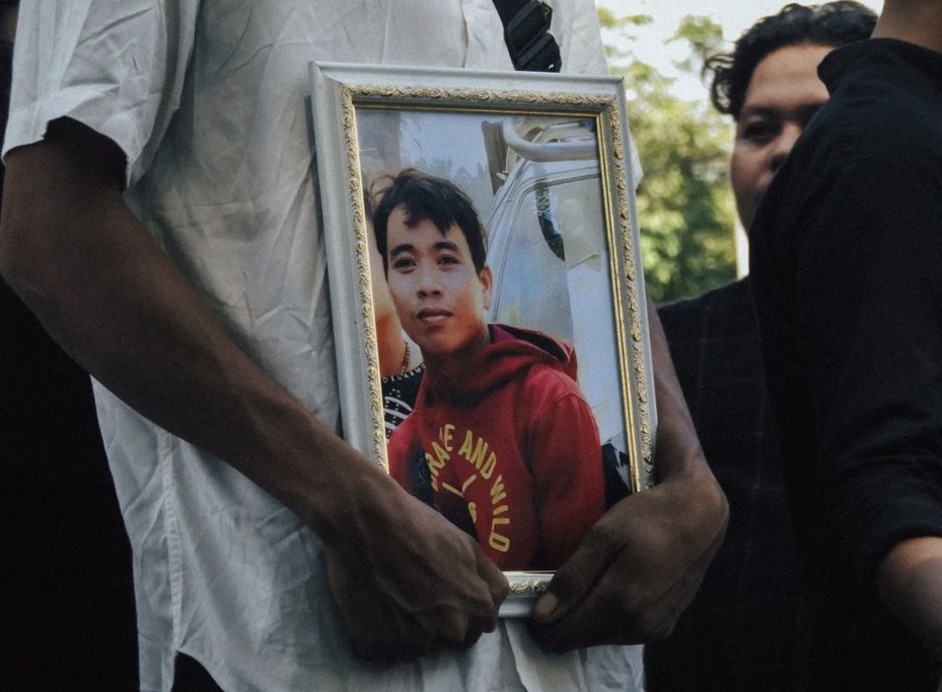
No one could tell what was running through Mana’s mind. From a distance, her eyes stared blankly at the grave of her son, Gijik, who was killed during a clash between Indigenous Bangkal villagers and police officers at the oil palm plantation of PT Hamparan Masawit Bangun Persada (HMBP) I on October 7, 2023.
Gijik, who was shot dead by police bullets, was laid to rest at the family cemetery, not far from their home in Bangkal Village, Seruyan Raya District, Seruyan Regency, Central Kalimantan. His grave was built monumentally, as if the family wished to honor him with a special resting place.
That afternoon, a few neighbors visited their home. Mana let her eldest son, Rius, greet the guests and invite them inside, while she sat quietly in a dim corner of the house. It was Rius and other relatives who conversed with the visitors.
According to Rius, the tragedy that befell Gijik left a deep scar on their family, especially their mother. She becomes easily emotional whenever Gijik is mentioned.
Rius said that although his mother never prohibited her children from participating in the protests to demand land rights from PT HMBP I, she never imagined that it would cost Gijik his life — even more bitterly, at the hands of law enforcement officers.
"Until now, we still cannot forgive the perpetrator," Rius said when interviewed at his home on November 12, 2024. What hurts even more, Rius added, is that the police officer who shot Gijik, Anang Tri Wahyu Widodo, was sentenced to only 10 months in prison by the Palangkaraya District Court.
|
Who is Best Agro International? Best Agro International is a large conglomerate involved in the palm oil plantation sector, with several subsidiaries spread across Indonesia. As a major player in the palm oil industry, Best Agro has multiple subsidiaries, including PT HMBP I and PT HMBP II, which have been involved in agrarian conflicts with local communities in Central Kalimantan. The company is known for its ongoing debates over corporate social responsibility (CSR) implementation and issues related to the respect for indigenous peoples' rights and smallholder farmers. In many cases, these companies are criticized for failing to meet their obligations, such as establishing plasma palm oil plantations, which leads to tension between the local population and the companies, eventually resulting in protests and violence. |
"If that’s the kind of justice we get, I would willingly serve 10 months in jail too if I could avenge my brother’s death," said Rius. "We cannot accept that my brother’s life was exchanged for just a 10-month sentence."
The family also repeatedly refused attempts at an out-of-court settlement offered by the police, even though they were offered 450 million rupiah (about $28,000). "The last time they came was in October, but we still rejected the money," Rius said.
Gijik’s death has left a deep void, especially for Mana, who lived with him. Gijik had been her primary support, while her other children had long since married and moved out.
Since his death, Mana has been receiving psychological counseling. Rius said she still breaks down emotionally whenever Gijik’s name is mentioned. "She won’t even watch any of the videos showing the evacuation after he was shot," he said.
As for Rius, he never missed a single court session during the trial in Palangkaraya. Even though the family received some financial assistance from various parties, Rius ended up selling his own house to cover the travel costs for attending the hearings.
Beyond that, Rius also continues the palm oil farm Gijik had started. Though Gijik had no formal employment, he owned an 11-hectare plot near their home.

A moment from the first anniversary of Gijik’s passing, observed by villagers at his gravesite in Bangkal Village, October 7, 2024. Source: Special
However, the farm was not yet profitable. In fact, it required significant investment for fertilizers and upkeep. "It was just beginning to bear young fruits. Gijik used to save money and go to Sampit to buy fertilizer and other supplies. But now he’s gone," Rius said.
Rius pledged to continue Gijik’s fight for the promised plasma land from PT HMBP. "That’s what my brother fought for. If another protest happens, I will join," he said.
Rius admitted that he had once received some payments from the company's plasma allocation program. But due to disputes over the area provided — only 433 hectares out of the 1,175 hectares demanded by the villagers — he eventually decided to withdraw from the program. "If I remember correctly, I only accepted the payment twice," he said.
He wasn’t even sure how his name ended up on the list of plasma recipients. All he knew was that he was given an ATM card to collect the monthly payment, supposedly worth around Rp300,000 (roughly $19), though he said the amount often fell short.
Being part of the plasma cooperative, Rius said, brought him more sadness than relief. "It’s heartbreaking that Gijik, who gave his life for this cause, wasn’t even included as a beneficiary. In other companies, even deceased members still receive plasma rights," he said.
Rius emphasized that he and his mother would continue fighting for the 1,175 hectares of land outside PT HMBP I’s HGU (Right to Cultivate) concession — the land the Bangkal villagers had long demanded. They refuse to accept the Rp300,000 monthly payments offered under the current settlement scheme. "What we want is land, not this pitiful amount of money," Rius said.
Justice denied

Hundreds of Bangkal villagers escort Gijik to his final resting place. Source: Special.
In the eyes of Sarianto, the field coordinator during the Bangkal villagers’ mass action at PT HMBP’s plantation, Gijik was a good man—simple, without pretense. His commitment to the fight for palm oil plasma rights from PT HMBP was unwavering. Gijik was present at every protest alongside other villagers.
Sarianto was among the eyewitnesses to the tragedy that befell Gijik. He saw firsthand how Gijik and Taufik fell to the ground amid the crackle of gunfire and a haze of tear gas filling the plantation. "When I saw Gijik and Taufik collapse, I ran and hid behind a palm tree," he recalled.
Initially, he and other villagers, including Gijik and Taufik, intended only to block police officers who were forcibly dispersing the residents occupying the plantation. Never did he imagine the police would use live ammunition against the Bangkal villagers that day.
Like Rius and Mana, Sarianto said he could not accept the fact that Gijik’s shooter received such a light sentence, and he hoped there would be another legal avenue to seek justice for Gijik.
"It’s as if Gijik’s life had no value," he said.
Yet, the path to further criminal prosecution was all but closed. After the Palangkaraya District Court sentenced the officer, Anang Tri Wahyu Widodo, to just 10 months in prison, the public prosecutor (JPU) did not file an appeal, much to the disappointment of Gijik’s family.
Rius, Gijik’s brother, expressed deep frustration over the lack of further legal action. However, the Palangkaraya Legal Aid Institute (LBH) recently advised the family to pursue a civil lawsuit instead. Through this route, Gijik’s family could seek restitution.
Previously, the Witness and Victim Protection Agency (LPSK) had formally recommended that the public prosecutor include a restitution claim in the indictment. But the recommendation was ignored and never raised during the trial.
According to an LPSK valuation, the family could claim about Rp2.2 billion (around USD 140,000) in restitution for the losses resulting from the unlawful act.
"For now, that’s the only legal route left for Gijik’s family," said Janang Firman Palanungkai, Advocacy, Research, and Campaign Manager at WALHI Central Kalimantan.
Janang himself was outraged by the light sentence imposed by the Palangkaraya court, an anger compounded by the prosecution’s failure to appeal.
"It’s as if Gijik’s death meant nothing to the legal system. Even during the trial, the prosecutor seemed to side more with the company and the defendant," he said.
Janang also noted serious irregularities during the proceedings. The court’s judgment cited a customary peace agreement between the defendant and the victims' families. However, in reality, such an agreement only involved Taufik, not Gijik.

The trial of Gijik’s shooter at the Palangkaraya District Court. Source: Advocacy Team for Solidarity with the Indigenous People of Bangkal.
No customary settlement was ever made with Gijik’s family.
"But the judge ignored that fact and ruled the shooting that killed Gijik as mere negligence," Janang said.
The argument that the shooting was a result of negligence, Janang stressed, was deeply questionable—especially considering that the defendant was a trained police firearms instructor.
"It’s impossible that this was just negligence. That argument is simply appalling," he said.
Janang emphasized that Gijik’s death—and the violent clash between Bangkal villagers and the police—would never have occurred if PT HMBP I had honored its long-standing promise to distribute plasma plantations to the villagers, a commitment made as far back as 2013.
The promise that never came
According to the timeline, a meeting between Bangkal villagers and PT HMBP I took place on October 26, 2013. The outcome was clear: alongside several demands related to corporate social responsibility (CSR), PT HMBP agreed to establish a plasma palm oil plantation for Bangkal residents. The plantation would be built outside the company’s official concession (Hak Guna Usaha, or HGU) area.
Under the agreement, PT HMBP I pledged to provide land—wherever available—granting two hectares to each household. The project was supposed to be completed no later than early January 2014.
All these commitments were formalized in an official meeting record, signed by several top executives of PT Best Agro International, the parent company of PT HMBP. Among the signatories were H.M. Wahyu Bima Dharta (Legal Manager), Paris Siahaan (General Manager), and M. Arief Nasution (Regional Officer). Their signatures were affixed on a stamped legal document.

Several villagers were arrested during the Bangkal residents’ mass protest demanding the promised plasma plantation at PT HMBP I, October 7, 2024. Source: Kalteng Today.
But more than a decade later, the promised plasma plantation—publicly acknowledged even by Seruyan’s then-deputy regent, Yulhaidir—has yet to materialize. Frustration has continued to simmer among the villagers.
According to James Watt, a Bangkal community leader, PT HMBP I recently claimed there was a 1,175-hectare tract of land available outside its HGU boundary.
"But we still don't know exactly where this land is," James said in an interview on November 12, 2024.
James recounted that on September 24, 2023, Bangkal villagers, along with the village government, local customary leaders, and community figures, held a meeting to address ongoing disputes with PT HMBP I—including the unfulfilled plasma promise.
During the meeting, several key demands were agreed upon to be relayed to PT HMBP I. Among them: a mediation to discuss the allocation of 240 hectares of plasma land, to be compensated through a Plasma Allocation Fund (Dana Alokasi Plasma, DAP), valued at Rp300,000 per hectare for life.
Additionally, the villagers demanded the immediate withdrawal of Brimob (Mobile Brigade Corps) forces from Bangkal village, insisting that only regular police officers be assigned to field security duties—not Brimob.
Bangkal villagers also reiterated their demand for the return of the 1,175 hectares of land outside PT HMBP I’s HGU to the community. "If mediation fails, we will escalate the matter to customary law proceedings, occupy the 1,175-hectare land, and launch a mass harvesting action," James warned.
A Structured Crime
Janang views the shooting of Gijik—and Taufik Nurahman, another victim left permanently paralyzed by live ammunition—as part of a structured crime. In his account, the tragedy initially stemmed from a straightforward demand: the fulfillment of a promised plasma palm oil plantation.
Instead of honoring their commitment, however, the company opted for a heavy-handed approach by mobilizing a large contingent of security forces.
"This, in turn, provoked a reaction from the villagers," Janang said.
According to Janang, this aggressive strategy is a familiar pattern with PT Best Agro International. In previous agrarian conflicts involving other subsidiaries—such as PT HMBP II in Kotawaringin Timur—several residents of Penyang Village were criminalized and imprisoned.
"One villager even died while serving their sentence," Janang recalled.
In August 2024, another subsidiary, PT Bangun Jaya Alam Permai (BJAP) III, also clashed with communities living near its plantation, leading to the burning of several company employees' homes. The root cause remained the same: broken promises surrounding plasma plantation development.
"Once again, they deployed massive security forces. There’s a pattern of structured crime here, and this corporate group behaves as if it’s above the law," Janang said.

Gijik's family gathers at his grave, located near their home. Source: Special.
The sense of impunity is palpable. Janang pointed out that instead of being held accountable for failing to fulfill their legal obligation to establish plasma plantations for nearby communities, the company was shielded by law enforcement—and tacitly by government authorities as well.
"The security forces assigned to protect the company, who then committed violence against the villagers, were themselves protected," he said.
In Janang’s view, the growing number of conflicts between villagers and subsidiaries of Best Agro Group is driven by widespread resentment toward companies perceived to offer no real benefits.
"Forget plasma plantations—even basic corporate social responsibility is non-existent. Instead, what we see is villagers losing their lives," he said.
To prevent further casualties, Janang urged the government to reevaluate palm oil plantation permits, especially in Central Kalimantan, and conduct thorough environmental audits.
He also emphasized the need for the government to assess whether the presence of palm oil companies has generated any real positive impact on surrounding communities.
"Especially considering how many of these companies operate illegally within forest areas and still have not delivered on their plasma obligations," he added.
Moreover, reflecting on the case of PT HMBP I, Janang said the fact that the company failed for over a decade to fulfill its plasma promises while enjoying the support of law enforcement agencies was alarming.
"This calls for a serious review of the role and accountability of the police," he concluded.