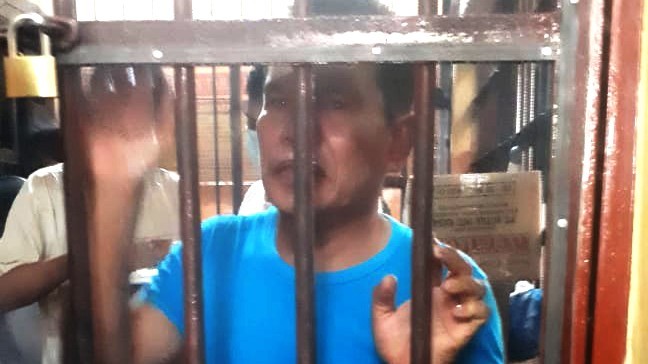
Syamsul Bahri and M. Samsir never dreamt their efforts to replant mangroves in their village; Hamlet III Lubuk Jaya, Kwala Serapuh village, Tanjung Pura subdistrict, Langkat district, North Sumatra, would lead to them being arrested by the police.
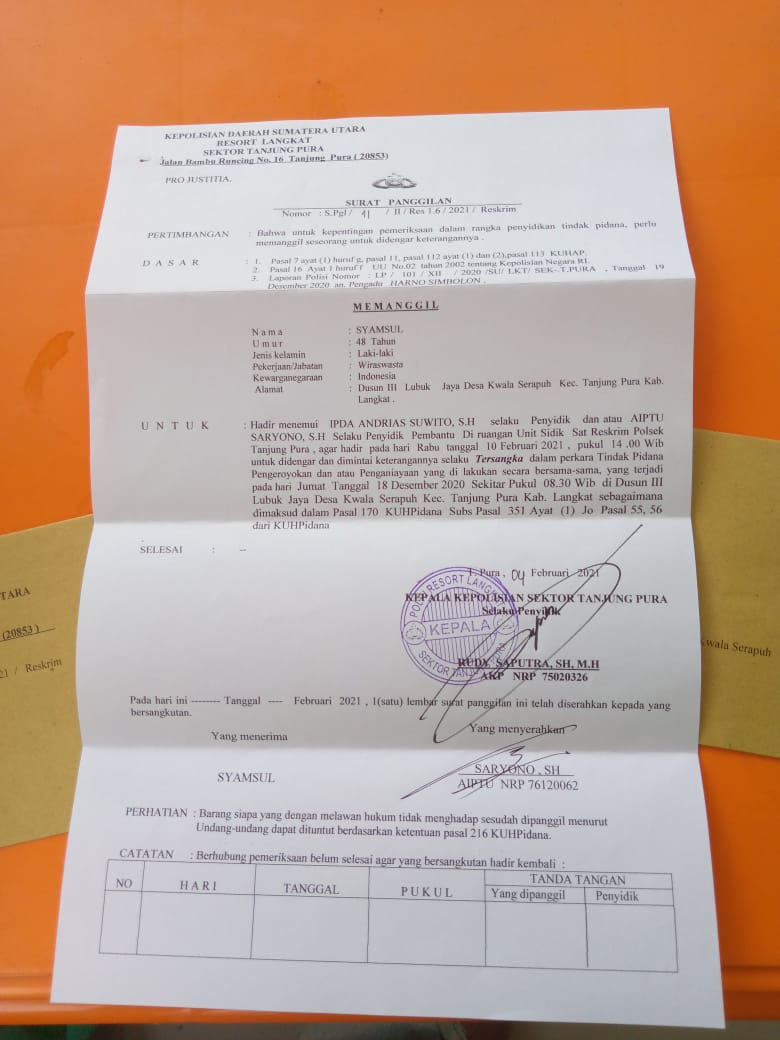
Syamsul, usually called Samsul, and Samsir were suddenly named suspects in a fabricated case, a summons saying the two had been named suspects in a case involving assault and battery.
However, it neglected to say who had been assaulted and/or battered. The only indication in the summons was a list of three considerations, one of which was a complaint made by Harno Simbolon on 18 December 2020. This might well have been because the Indonesian legal system allows the possibility of complaints being made not only by victims, but also by eyewitnesses.
Around a week earlier on 28 January 2021, the two had received a police summons, but ignored it as it was not addressed to their home, but to an address in the neighboring hamlet. Days earlier, Samsul and Samsir had felt certain they were being watched, and a rumor was circulating that the two would be arrested.
The connection with Harno Simbolon appeared to reference an incident on Friday, 18 December 2020. That day, as relayed by the Langkat East Coast Mangrove Rescue Movement (GEMPITA), 30 members of the Nipah Farmer Group led by Samsul were working together to rehabilitate mangroves in Hamlet III Lubuk Jaya, Kwala Serapuh village, Tanjung Pura subdistrict, Langkat district, North Sumatra.
After a short time, Harno Simbolon appeared with a friend, thought to be an oil palm plantation employee, and started taking photos. Samsul approached them shouting, “What’s going on?” On seeing the situation, the farmer group members approached. Harno retreated, and phoning his colleagues was heard to say, “I’ve been beaten up”. He then dived into the river.
Fearing Harno would drown or be carried away by the fast-flowing river, members of the farmer group boarded their boat to save him, bring him back to dry land and at the same time clarify his claim of being beaten up.
Referencing the police summons, it seems Harno filed a complaint about the incident to the police. Yet, as captured on video, Harno said there was no physical violence involved in the incident. However, Langkat Chief of Police, Edi Suranta Sinulingga, through a WhatsApp chain message as quoted by the media said the video was a form of intimidation against Harno.
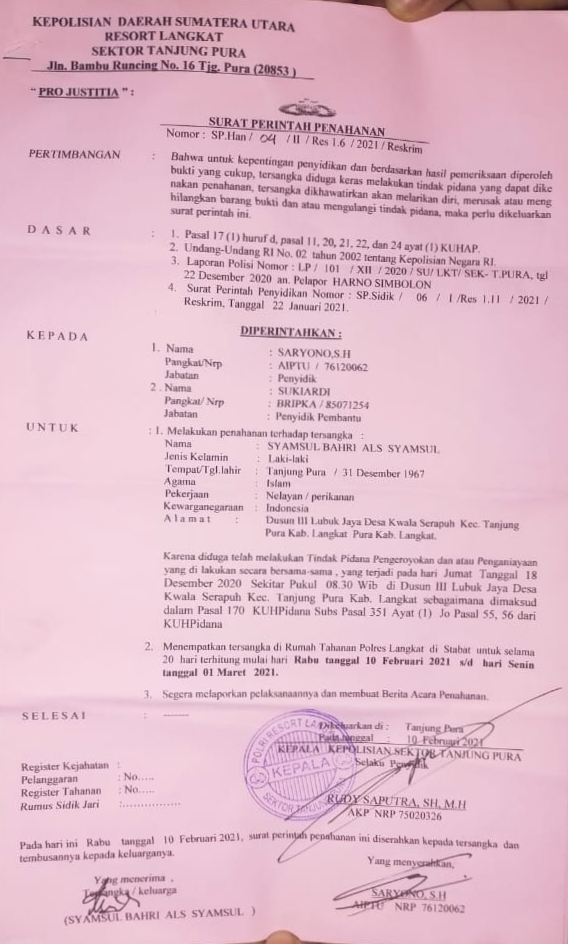
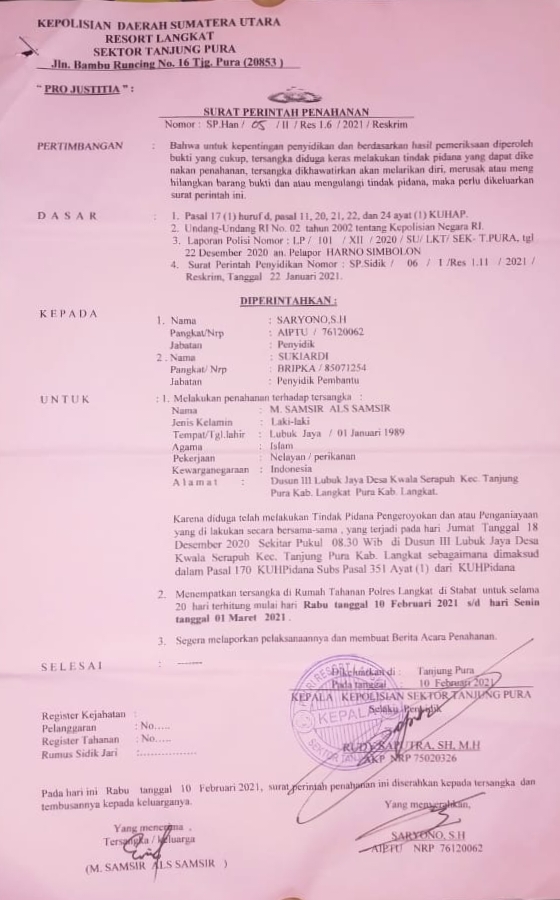
On 10 February 2021, the police arrested Samsul and Samsir. Their naming as suspects without any prior interrogation raises questions in its own right.
A series of irregularities triggered suspicions of criminalization against the farmer group, as alleged by Nipah Farmer Group facilitators including Srikandi Lestari, WALHI North Sumatra, and the Medan Legal Aid Institute.
The police’s swift arrest of Samsul and Samsir stands in stark contrast to their handling of a farmer group complaint when on discovering their mangroves had been destroyed on 30 September 2018, they reported the incident to the police. Police handling of the report remains unclear until now.

----
Facing the Strait of Malacca, Kwala Serapuh is one of many villages in Langkat district on the east coast of North Sumatra. The village’s mangroves form part of the largest mangrove in the province. Of the province’s 36,388 hectares of mangroves, 16,713 hectares or almost half are in Langkat district spanning the subdistricts of Secanggang, Tanjung Pura, Gebang, Pangkalan Susu, and Pangkalan Berandan.
The assorted Rhizophora, Bruguera and Avicenna trees inhabiting the mangrove ecosystem are spawning grounds for fish that provide a community livelihood source. Local inhabitants cannot compete with large boats for offshore catches, so traditional fishing is the option left open to them.
Unfortunately, since the 1990s, many mangroves have been converted to aquaculture ponds and oil palm plantations, particularly in the three villages of Kwala Serapuh and Bubun in Tanjung Pura subdistrict, and Kuala Gebang in Gebang subdistrict. Now much of the coastline where the sea used to lap against mangroves is now lined with aquaculture ponds or oil palm. Today, mangroves are only found in river estuaries and along paluh (river tributaries commonly found in mangrove ecosystems).
Most aquaculture ponds and oil palm plantations are owned by incoming individuals or corporations, with businesses on average controlling 50-200 hectares of oil palm plantations, and 5-20 hectares of aquaculture ponds. As most of the region constitutes forest estate, presumably these businesses have failed to follow procedures, or have even broken the law.
Traditional fishing communities in the three villages are feeling the immediate impacts of this mangrove conversion. In addition to fish numbers in rivers falling drastically, the absence of safe spawning grounds for sea fish has caused numbers in traditional fishing areas to fall as well. The villagers opposed mangrove conversion, since at least 2011.
As the situation continued, in 2016, villagers opposing conversion formed the Nipah Farmer Group and moved to rehabilitate mangroves. Replanting began in earnest with group members planting mangrove trees (Rhizophora sp.), nipa palms (Nypa fruticans), and various woody species.
Two years later on 23 April 2018, the group’s endeavors were officially recognized as government partnership activities through a collaboration agreement with the Stabat Region-1 Forest Management Unit (KPH) under the North Sumatra Provincial Forestry Office. Under the agreement, 242 hectares of production forest became the collaboration location, with the Ministry of Environment and Forestry (MoEF) recognizing it as a Forestry Partnership Protection Acknowledgement (Kulin KK) scheme.
The agreement document recorded 64 hectares of illegal oil palm in the collaboration area, and the farmer group actively thinned out the palms replacing them with mangrove species.
The Nipah Farmer Group’s mangrove rehabilitation gradually restored the local ecology, boosting the local economy as fish and crabs returned to the mangroves, and the local populace could utilize nipa palm leaves to make food packaging for Langkat specialties. Unsurprisingly, fishing families outside the farmer group also began planting, maintaining and guarding mangroves.
However, illegal oil palm and aquaculture owners responded negatively to their efforts. The Nipah Farmer Group often experienced pressure and intimidation, and their rehabilitation plantings were destroyed or even burned, as occurred on 26 March 2020. Two months later on 12 May 2020, the group allegedly experienced intimidation when an oil palm owner appeared with six men in military uniform in tow.
“We (the farmer group) often suffer intimidation from the businesses or financiers converting mangroves,” said Samsul in an interview with Mongabay.
The Nipah Farmer Group’s efforts should be supported, especially by the government. The Stabat KPH and MoEF have already acted appropriately by supporting the group’s mangrove rehabilitation efforts. Therefore, the Chief of Police of the Republic of Indonesia needs to ensure his subordinates comply with the law; the Chief of the Indonesian Armed Forces needs to make sure none of his members violate the Sapta Marga code of honor by backing illegal businesses, and the Attorney’s Office should immediately ask investigators to address the illegal oil palm and aquaculture businesses responsible for destroying mangroves.