July 2020—SEVERAL people in orange uniforms suddenly appeared at the Walhi East Kalimantan office in Samarinda on 30 July last year. They arrived carrying disinfectant sprayers. Without warning, let alone waiting for the hosts’ consent, Covid-19 disinfectant fluid was sprayed over every wall in the Indonesia Forum for Environment headquarters.
One officer then pronounced, just like a judge passing sentence, that three people in the office were Covid-19 positive. Naming Walhi East Kalimantan Director, Yohana Tiko, he also declared two activists from the Samarinda Legal Aid Institute Working Group 30 (Pokja 30), Bernard Marbun and Fathul Huda, were positive. Pokja 30, a non-governmental organization that monitors corruption and budget transparency issues in East Kalimantan, has an office near Walhi.
A day earlier, the Samarinda Health Office had indeed conducted random Covid-19 tests in the Walhi and Pokja 30 offices. The polymerase chain reaction (PCR) swab tests had been conducted because, according to the Health Office officers, there was a new outbreak around the Pokja 30 Secretariat. Eight activists had been tested in the Pokja 30 office, including Bernard Marbun and Fathul Huda. From there, testing moved on to the Walhi office.
The health officer said Yohana, Bernard and Fathul must be treated in the Inche Abdoel Moeis General Hospital. But Yohana refused their order.
Yohana doubted the results of her Covid test had already come out, given it was only one day after the PCR swab test. The laboratory had previously required 4-5 days to finalize test results. Yohana’s suspicion grew stronger as the officers failed to bring evidence of the PCR test results with them to the Walhi office.
.jpg)
Officer without full protective gear conducting a rapid antigen test in the Walhi East Kalimantan office. Photo: kaltimkece.id
Suspicions arose that Covid-19 was merely a pretence for shutting down their office activities as they were in the process of protesting plans to move the national capital city to North Penajam Paser and Kutai Kartanegara districts in East Kalimantan, and the discourse had triggered conflicts with communities.
Moreover, throughout the month, several national and regional Walhi activists had also endured criminalization. A week earlier, on 23 July, police had ransacked the rented home of Walhi National Executive Advocacy Department Head, Zenzi Suhadi in Jakarta. The serious, but unproven accusation was that Zenzi was in possession of drugs. In the same month, Walhi South Sulawesi Director, Muhammad Al-Amin was subject to threats after one of his activists, Slamet Riyadi, and a fisherman named Marne were arrested by police on 14 August, accused of vandalism when protesting sand mining ship operations.
Irregularities had already been apparent since the Covid-19 tests were carried out. According to Bernard, medical officers arrived without any protective gear. When asked to show their duty letters, the officers told them to wait until the samples had been taken. "However, after the testing they still didn’t show me the duty letter I’d asked for," he said.
The three associates’ suspicions were reinforced when they went to Inche Abdoel Moeis General Hospital on 31 July. They were treated like Covid-19 patients, but were shown no evidence of being positive. Yohana questioned medical officers about the positive Covid-19 test results. "But they said, ask the ones who brought you here, we don’t know about that. We just receive admissions," said Yohana.
Finally, the three associates were left unattended in the hospital car park. Several hours passed before they were handed statement letters saying they refused treatment at the hospital, which of course they did not sign.

Land prepared for infrastructure development for the new national capital in Penajam Paser, East Kalimantan. Photo: Trend Asia
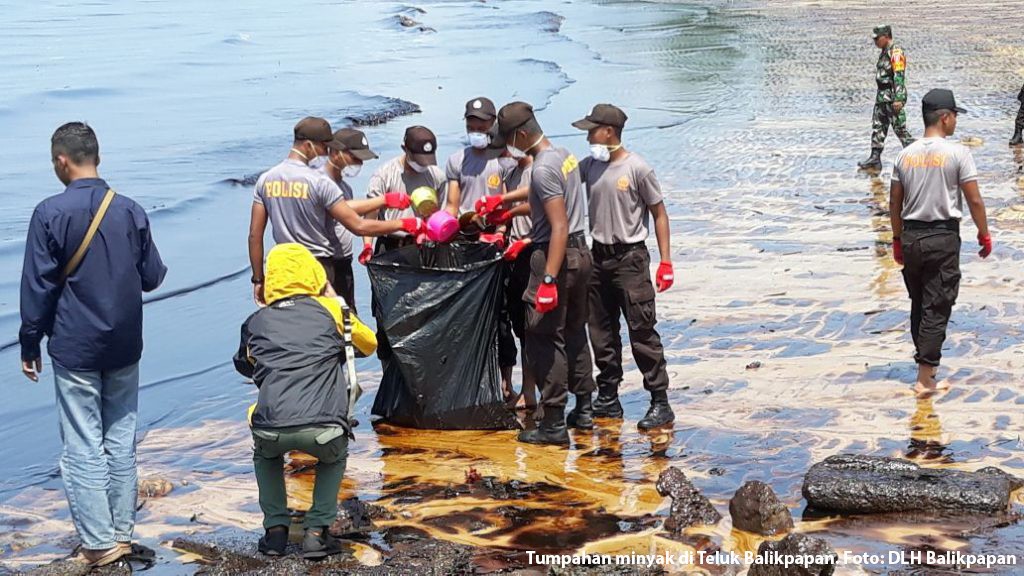
Yohana alleged this use of Covid-19 status to obstruct them relates to a number of cases Walhi East Kalimantan is currently advocating, including a lawsuit over oil spills in Balikpapan Bay jointly initiated with the Mining Advocacy Network, Pokja 30, and the Samarinda Legal Aid Institute.
The lawsuit stemmed from public anger over the conduct of large vessels always “defecating” in Balikpapan Bay. Despite three oil spills being recorded in the previous three years, only one was investigated by the police. Consequently, they asked the regional government to be serious in preparing a Coastal Region and Small Island Zonation Plan (RZWP3K) and apply standard operational procedures to prevent oil spills. In the lawsuit, the panel of judges granted several of its many claims aimed at the East Kalimantan Governor.
Walhi East Kalimantan is also in the middle of handling a tenurial conflict between villagers from Lebak Cilong in Kutai Kartanegara district, whose region falls within the map of the planned national capital city, and an industrial plantation forest company. "The company concession belongs to a conglomerate, and half of it has already been given to the government for the new national capital," said Yohana.
Walhi East Kalimantan together with a civil society coalition comprising the Mining Advocacy Network, Trend Asia, Forest Watch Indonesia, Pokja 30, and various other organizations, also found a number of issues with the prospective site for the new capital city, including potential environmental destruction, land tenure problems, and the move only benefiting extractive industry corporations.
Despite the absence of clear proof, indications are that because of these issues, efforts were made to silence the three associates.